
Why Local Rock Helps Keep South Florida Affordable
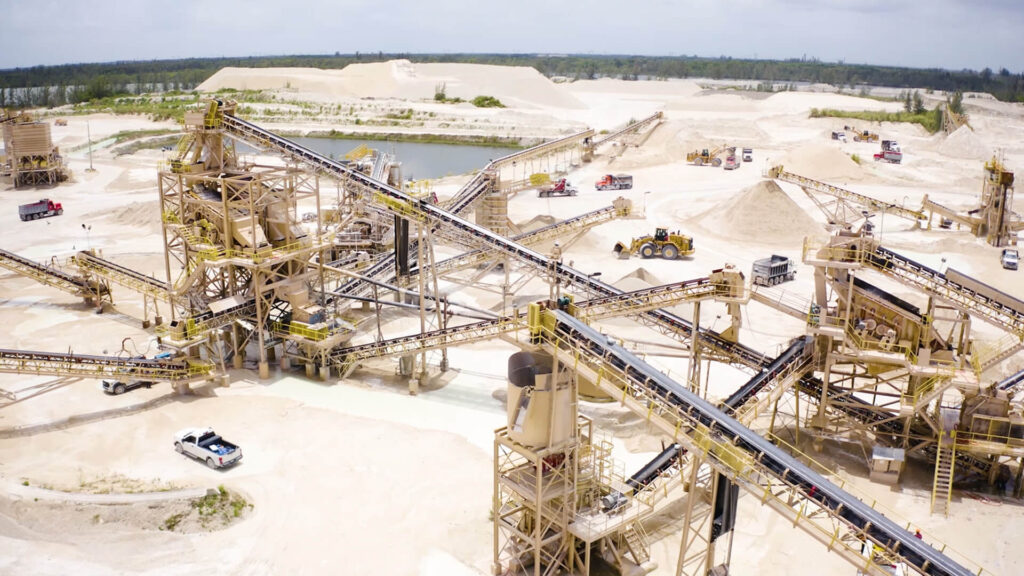
August 4, 2026 Whether you realize it or not, limestone aggregate plays a vital role in building Florida’s infrastructure, and that critical infrastructure requires an essential resource found right here in Miami-Dade’s Lake Belt region: limestone.
Crushed limestone, when used as an aggregate, offers the perfect balance of engineering performance, durability, and economic efficiency, making it well-suited for a wide range of construction applications.
Here are three reasons why limestone aggregate is a top choice for Florida’s infrastructure needs.
1. It’s Local and Abundant
The Lake Belt supplies roughly 40 percent of Florida’s crushed stone and about half of the state’s FDOT-grade construction aggregate. That much high-quality limestone produced locally means less hauling and steadier prices for the roads, schools, and public infrastructure on which our communities depend.
The value of that proximity is hard to overstate. Federal researchers have found that hauling aggregate just 30 to 50 miles can double or even quadruple its cost compared to the price at the quarry (United States Geological Survey, 2002). When the source is local, that multiplier never kicks in.
2. It Holds Up in South Florida’s Harsh Conditions
Limestone is porous, and in base and drainage work, that same property is exactly why it works so well. Crushed limerock compacts into a dense load-bearing layer over sandy subgrade and allows rainwater to permeate down to Florida’s natural aquifers.
Limestone also has a low thermal coefficient of expansion, so slabs poured with it swell and shrink less than slabs poured with other types of aggregates. In a place that runs 90 degrees half the year, that’s the difference between a road that lasts and a road that needs patching.
3. It’s Easy to Grab Onto and Doesn’t Fight the Cement
Crushed limestone has irregular surfaces that cement is able to lock onto much more easily than other types of aggregates. In fact, researchers at National Institute of Standards and Technology (NIST) describe limestone as forming a superior bond with hydrating cement paste.
Silica in some stone can also react with alkalis in the cement and crack concrete from the inside over decades. Limestone is a carbonate, so that reaction does not occur.
Almost every major construction project in Florida starts with the same question: Where’s the rock? The answer is right under our feet, and nothing else fills its role quite as well.
Learn more at mdlpa.org/our-products-are-essential-to-american-infrastructure/